

Financial Analyst Job Description: Roles, Skills & Salary Guide (2026)
A clear financial analyst job description helps companies attract data-driven finance professionals who can turn complex numbers into profitable business decisions. Whether you are an HR manager drafting a job post for a growing enterprise or a finance professional preparing for your next corporate role, defining exact expectations is essential in 2026.
As businesses across India expand into new markets and navigate tighter margins, the demand for skilled financial analyst talent has surged across BFSI, IT, manufacturing, and e-commerce sectors. Below, you will find a ready-to-use copy-paste job description template, core financial analyst roles and responsibilities, required technical skills, and updated 2026 salary benchmarks.
What Does a Financial Analyst Do?
A financial analyst evaluates historical and current financial data, builds forecasting models, tracks budget variances, and advises leadership on investments, cost optimization, and revenue growth. By translating raw accounting figures into actionable strategic insights, a financial analyst enables executives to make informed capital allocation decisions.
Unlike accountants who focus primarily on recording past transactions and regulatory compliance, a financial analyst looks forward. They analyze market trends, unit economics, and operational KPIs to predict future business performance.
(According to the CFA Institute’s corporate finance career framework, modern financial analysts increasingly blend traditional valuation skills with data visualization and automated BI reporting)
Copy-Paste Financial Analyst Job Description Template (2026)
Use this customizable financial analyst job description template when posting openings on job portals or sharing mandates with recruitment partners:
Job Title: Financial Analyst (FP&A / Corporate Finance)
Location: [City Name, e.g., Gurgaon / Delhi NCR / Bangalore / Mumbai / Pune]
Employment Type: Full-Time
Experience Level: [2–5 Years / Mid-Senior Level]Job Summary:
We are seeking a detail-oriented and analytical Financial Analyst to join our corporate finance team. The ideal candidate will be responsible for financial planning and analysis (FP&A), budgeting, forecasting, variance analysis, and building dynamic financial models to support executive decision-making.Key Responsibilities:
- Prepare monthly, quarterly, and annual financial forecasts, budgets, and management MIS reports.
- Analyze financial performance against budgets (Actual vs. Budget variance analysis) and identify cost-saving opportunities.
- Build and maintain complex three-statement financial models (P&L, Balance Sheet, Cash Flow) for new projects and capital investments.
- Evaluate market trends, competitor benchmarks, and pricing strategies to guide senior leadership.
- Collaborate with accounting, sales, and operations teams to track departmental KPIs and working capital efficiency.
Required Qualifications & Skills:
- Bachelor’s degree in Finance, Accounting, Economics, or Commerce (MBA Finance, CA, CMA, or CFA preferred).
- Proven experience of [X]+ years in financial analysis, FP&A, corporate finance, or investment research.
- Advanced proficiency in Microsoft Excel (financial modeling, macros, pivot tables) and PowerPoint.
- Hands-on experience with ERP systems (SAP, Oracle) and BI tools (Power BI, Tableau, or SQL).
- Strong analytical mindset, attention to detail, and executive presentation skills.
What Are the Core Financial Analyst Roles and Responsibilities?
Core financial analyst roles and responsibilities include financial modeling, annual budgeting, monthly variance reporting, profitability analysis, and investment valuation. In mid-to-large enterprises, analysts also partner with business unit heads to monitor cash flow, assess operational risks, and prepare board-level financial presentations.
Depending on the industry vertical, day-to-day duties typically fall into four key areas:
- Financial Planning & Budgeting (FP&A): Coordinating with department heads to consolidate annual operating budgets and rolling quarterly forecasts.
- Variance & Trend Analysis: Investigating why actual revenues or expenses deviated from projections and recommending corrective actions.
- Investment & ROI Evaluation: Assessing mergers, capital expenditure (CapEx), new product launches, or market expansion using NPV, IRR, and payback period metrics.
- Executive Dashboarding & MIS: Automating weekly and monthly KPI dashboards so C-suite leaders have real-time visibility into gross margins and cash burn.
Struggling to shortlist qualified finance talent on tight deadlines?
With 18+ years of recruitment expertise (established in 2008), 1,000+ corporate clients, and 10,00,000+ scanned resumes, Om Sai Group Consultancy delivers pre-verified Financial Analysts, Finance Managers, and CAs across India.
Which Skills & Qualifications Should Employers Look For?
Employers hiring a financial analyst should prioritize a strong foundation in accounting principles, advanced Excel financial modeling, ERP familiarity, and business communication. Certifications such as MBA (Finance), Chartered Accountant (CA), CMA, or CFA add strong technical credibility for mid-to-senior corporate roles.
| Skill Category | Must-Have Competencies (2026 Standard) |
|---|---|
| Core Finance & Accounting | 3-Statement Modeling, DCF Valuation, Ratio Analysis, Budgeting & Forecasting, Cost Accounting |
| Technical & Analytics Tools | Advanced Excel, Power BI / Tableau, SQL (for large datasets), SAP FICO / Oracle NetSuite |
| Soft & Business Skills | Stakeholder Management, Executive Storytelling, Commercial Acumen, Problem-Solving |
| Preferred Credentials | B.Com / BBA (Finance) + MBA (Finance), CA, ICMAI (CMA), or CFA Level II/III |
What is the Average Financial Analyst Salary in India (2026)?
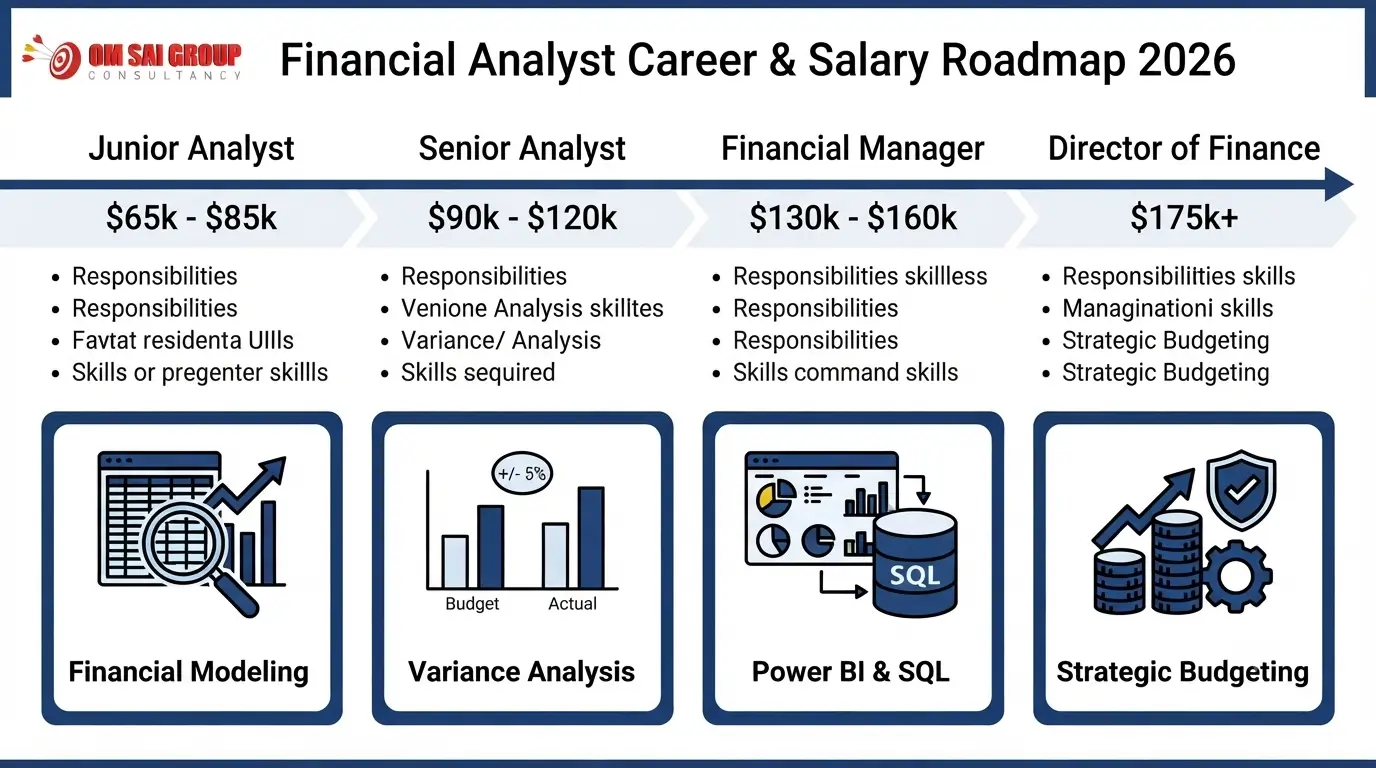
The average financial analyst salary in India in 2026 ranges from ₹4.5 LPA to ₹7.5 LPA for entry-level analysts, ₹8 LPA to ₹15 LPA for mid-level professionals, and ₹16 LPA to ₹28+ LPA for senior financial analysts. Compensation varies based on city tier, industry sector, and specialized certifications like CA or CFA.
| Experience Level | Typical Role Title | Average Annual CTC (India 2026) | Top Hiring Hubs |
|---|---|---|---|
| 0 – 2 Years (Entry-Level) | Junior Financial Analyst | ₹4.5 LPA – ₹7.5 LPA | Delhi NCR, Mumbai, Bangalore, Pune |
| 3 – 6 Years (Mid-Level) | Financial Analyst / Senior FP&A Analyst | ₹8.0 LPA – ₹15.0 LPA | Gurgaon, Mumbai, Hyderabad, Chennai |
| 7 – 10+ Years (Senior) | Lead Financial Analyst / Finance Manager | ₹16.0 LPA – ₹28.0+ LPA | Mumbai, Bangalore, Delhi NCR, Kolkata |
How Can Companies Hire a Pre-Verified Financial Analyst Quickly?
Companies can hire a pre-verified financial analyst quickly by partnering with a specialized recruitment agency that conducts technical financial modeling assessments and background verification before scheduling interviews. This eliminates irrelevant portal applications and cuts hiring timelines by up to 50%.
Are you a finance professional looking for your next role?
Register with Om Sai Group Consultancy to connect directly with top MNCs and growing enterprises hiring across India.
[Upload Your CV via E-Recruitment ]
Frequently Asked Questions (FAQs)
1. What is the main purpose of a financial analyst job description?
A financial analyst job description clearly outlines the analytical, budgeting, modeling, and reporting responsibilities of the role so employers attract candidates with the right technical tools and industry background.
2. Is coding required for a financial analyst in 2026?
While traditional coding is not mandatory for every role, basic knowledge of SQL and Python—alongside Advanced Excel and Power BI—gives candidates a major advantage in data-heavy MNCs and FinTech firms.
3. What is the difference between an Accountant and a Financial Analyst?
An accountant focuses on historical financial record-keeping, tax compliance, and auditing, whereas a financial analyst uses that financial data to forecast future performance, evaluate investments, and guide business strategy.
4. How does Om Sai Group Consultancy help businesses hire finance professionals?
Om Sai Group Consultancy provides end-to-end permanent recruitment, executive search, and contract staffing for finance roles—delivering pre-verified candidates matched to your exact industry and budget criteria.