Education Sector Recruitment Agency: Building Strong Educational Institutions Through Strategic Hiring
The education sector is one of the most important pillars of any country’s development. Schools, colleges, universities, coaching institutes, vocational training centers, and EdTech organizations all depend on qualified teachers, academic leaders, and support professionals to deliver quality education. However, finding the right talent has become increasingly challenging. Institutions are looking beyond academic qualifications and now prioritize teaching ability, communication skills, digital learning experience, classroom management, and leadership potential. As a result, professional education recruitment services have become an essential part of modern hiring.
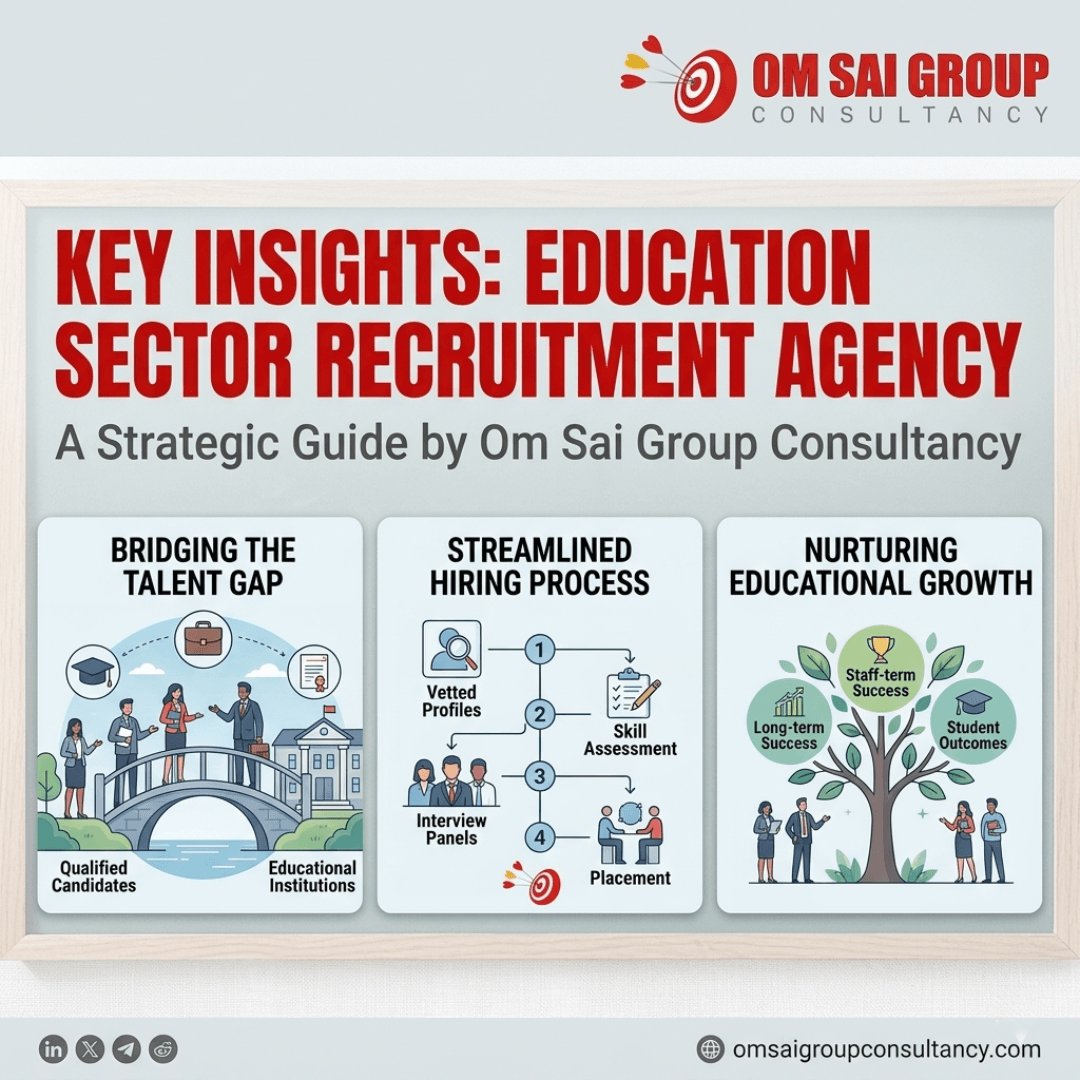
An experienced Education Sector Recruitment Agency helps institutions simplify the recruitment process by identifying qualified candidates, conducting preliminary screening, coordinating interviews, and supporting employers until successful onboarding. Instead of spending weeks reviewing hundreds of applications, educational institutions receive carefully shortlisted professionals who match their curriculum, culture, and long-term objectives.
At Om Sai Group Consultancy, recruitment for the education sector is treated as a strategic partnership rather than simply filling vacancies. Every institution has different academic goals, teaching methodologies, and staffing requirements. By understanding these expectations in detail, the recruitment team develops a customized hiring strategy that helps schools and colleges build high-performing academic teams.
What Is an Education Sector Recruitment Agency?
An Education Sector Recruitment Agency is a specialized consultancy that helps educational institutions recruit teachers, professors, principals, academic coordinators, counselors, librarians, administrators, and other education professionals.
Unlike general recruitment firms, education-focused recruiters understand curriculum requirements, qualification standards, subject specialization, and the skills required for different academic positions. This industry knowledge enables them to recommend candidates who are not only technically qualified but also suitable for the institution’s teaching philosophy and work culture.
The recruitment process generally includes:
- Understanding hiring requirements.
- Preparing recruitment strategies.
- Candidate sourcing.
- Resume screening.
- Qualification verification.
- Initial interviews.
- Communication assessment.
- Employer interview coordination.
- Offer management.
- Joining support.
This structured process reduces hiring time while improving the quality of recruitment.
Why Educational Institutions Need Professional Recruitment Support
Educational institutions face increasing competition to attract experienced teachers and academic professionals. Qualified educators often receive multiple employment opportunities, making recruitment both time-consuming and competitive.
Common hiring challenges include:
- Shortage of experienced teachers.
- Difficulty recruiting subject specialists.
- High recruitment workload for HR teams.
- Long hiring cycles.
- Last-minute vacancies.
- Faculty retention challenges.
- Leadership hiring requirements.
- Growing demand for digital teaching skills.
Without a structured recruitment process, institutions may experience delayed academic sessions, increased administrative workload, and inconsistent teaching quality.
Professional recruitment agencies help overcome these challenges by maintaining access to extensive talent networks and following systematic candidate evaluation methods. This allows schools and colleges to focus on delivering quality education while recruitment specialists manage the hiring process.
Educational Professionals We Help Recruit
Every educational institution has unique staffing requirements. Some require experienced classroom teachers, while others focus on leadership hiring or specialized faculty members.
An experienced Education Sector Recruitment Agency can assist in recruiting:
| Academic Position | Typical Hiring Requirements |
| Pre-Primary Teachers | Early childhood education experience |
| Primary Teachers (PRT) | Subject knowledge and classroom management |
| TGT Teachers | Specialized subject expertise |
| PGT Teachers | Advanced subject qualifications |
| Montessori Teachers | Child-centered teaching experience |
| School Coordinators | Academic planning and supervision |
| Vice Principals | Leadership and administration |
| Principals | Institutional management experience |
| College Lecturers | Higher education specialization |
| Assistant Professors | Research and teaching background |
| Professors | Academic leadership and expertise |
| Librarians | Information management skills |
| School Counselors | Student guidance and counseling |
| Special Educators | Inclusive education expertise |
| Administrative Staff | School operations and coordination |
Each role requires a different evaluation process, making specialized recruitment support valuable for educational organizations.
Recruitment Challenges in the Education Sector
Recruiting for educational institutions is different from hiring in many other industries. Schools and colleges must balance academic qualifications with teaching effectiveness, communication abilities, and long-term commitment.
Some of the most common challenges include:
- Limited availability of experienced faculty members.
- Recruiting teachers for Mathematics, Science, Computer Science, and Languages.
- Evaluating classroom communication skills before hiring.
- Verifying educational qualifications and experience.
- Managing multiple vacancies before the academic session begins.
- Maintaining consistency in hiring standards across campuses.
Educational institutions also increasingly seek professionals who are comfortable with digital learning platforms, blended classrooms, and technology-enabled teaching. These evolving expectations make recruitment more specialized than ever before.
How Om Sai Group Consultancy Supports Educational Recruitment
Recruitment in the education sector begins with understanding the institution rather than simply collecting resumes. Om Sai Group Consultancy follows a structured recruitment methodology that focuses on identifying professionals who can contribute to both academic excellence and institutional growth.
The process starts with detailed discussions with school management, HR teams, or trustees to understand curriculum requirements, teaching positions, qualifications, experience levels, salary ranges, and joining timelines. Based on these discussions, recruiters create a customized hiring strategy.
Candidates are sourced through multiple channels, including an internal database of education professionals, academic referrals, education job portals, professional networking platforms, alumni connections, and targeted outreach campaigns. Each profile is evaluated carefully for academic qualifications, teaching experience, subject expertise, communication ability, and overall suitability.
Shortlisted candidates undergo preliminary interviews, qualification verification, and professional assessments before being recommended to the institution. Where required, Om Sai Group Consultancy also coordinates demo classes, panel interviews, reference verification, offer discussions, and onboarding support. This structured recruitment model helps institutions reduce hiring time while improving the quality of faculty selection.
Benefits of Partnering with an Education Recruitment Agency
Working with a specialized recruitment partner provides several advantages:
- Faster hiring cycles.
- Access to pre-screened academic professionals.
- Reduced administrative workload.
- Better quality of shortlisted candidates.
- Industry-specific recruitment expertise.
- Support for bulk hiring before academic sessions.
- Assistance with leadership recruitment.
- Improved hiring consistency across campuses.
These benefits allow educational institutions to concentrate on student success while recruitment experts manage talent acquisition efficiently.
FAQs About Education Sector Recruitment Agencies
What does an education sector recruitment agency do?
An education sector recruitment agency helps schools, colleges, universities, and training institutions source qualified teaching, administrative, and leadership professionals through specialised screening and placement processes.
Why should schools use a specialised recruitment agency?
Specialised agencies understand educational qualifications, institutional culture, safeguarding requirements, and sector-specific staffing needs—resulting in better candidate alignment and faster placements.
Can recruitment agencies provide temporary education staff?
Yes. Many agencies offer temporary, contract, and permanent staffing support depending on institutional requirements and workforce demands.
Do education recruitment agencies work with universities?
Absolutely. Many agencies support higher education institutions by sourcing lecturers, professors, deans, academic coordinators, and research faculty.
How do recruitment agencies assess education candidates?
Assessment typically includes qualification verification, experience review, interview screening, communication evaluation, reference checks, and role-specific competency analysis.
Are recruitment agencies suitable for small schools?
Yes. Small and mid-sized schools often benefit significantly by outsourcing staffing processes to specialist agencies, reducing internal workload and improving placement quality.
How quickly can an agency fill academic vacancies?
Timelines vary by role complexity, but specialist agencies often reduce placement time substantially through established candidate networks and pre-screened talent pools.
Final Thoughts
A high-performing educational institution is built upon exceptional people. Partnering with a specialist Education sector recruitment agency empowers institutions to attract top-tier academic and operational talent while maintaining strategic focus on educational excellence. In an environment where staffing quality directly influences student outcomes, institutional reputation, and long-term growth, expert recruitment support is no longer optional—it is essential.