

Building an efficient organization is not just about hiring talented professionals—it is equally about how you structure your reporting lines. When one manager supervises too many employees, decision-making slows down and burnout rises. Conversely, when there are too many management layers, operational costs skyrocket and communication gets distorted.
This is where understanding the span of control in HR becomes critical for business owners, plant heads, and HR leaders. Whether you are scaling an IT startup, managing a manufacturing plant, or expanding retail operations, getting your manager-to-employee ratio right directly impacts productivity, employee retention, and profitability.
In this complete guide, we explain what span of control means, compare wide vs. narrow structures, and share ideal ratios across different industries.
What is Span of Control in HR?
In human resources and organizational management, span of control (also known as span of management) refers to the exact number of direct subordinates or team members that a single manager or supervisor effectively oversees.
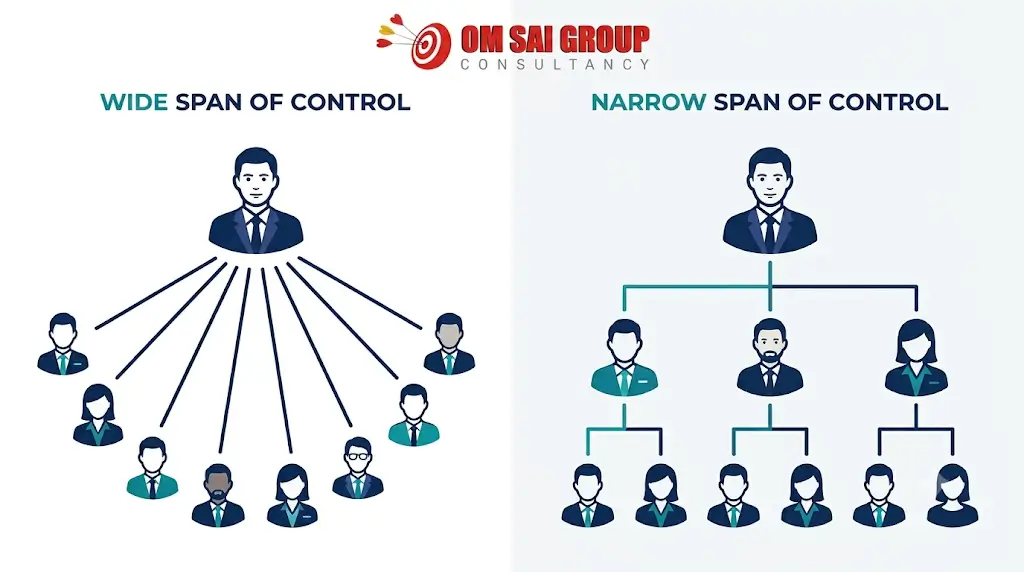
For example, if an IT Project Manager directly supervises eight software developers, their span of control is 1:8. If a Production Head oversees four shift supervisors on a factory floor, their span of control is 1:4.
Calculating and optimizing your span of control in HR helps companies answer three fundamental questions:
- How many management layers does our organization truly need?
- Are our team leaders overloaded with administrative supervision?
- Where can we streamline leadership roles to reduce unnecessary payroll overhead?
Wide vs. Narrow Span of Control: Key Differences
Depending on company size, work complexity, and leadership style, organizations typically follow either a wide (flat) or narrow (tall) span of control. Here is how both models compare:
| Feature | Wide Span of Control (Flat Structure) | Narrow Span of Control (Tall Structure) |
|---|---|---|
| Direct Reports per Manager | High (typically 10 to 20+ employees) | Low (typically 3 to 7 employees) |
| Management Layers | Few layers; closer connection to leadership | Multiple layers of middle management |
| Decision-Making Speed | Fast and agile | Slower due to multi-level approvals |
| Supervision Level | High employee autonomy; minimal micromanagement | Close supervision, coaching, and quality checks |
| Payroll & Overhead Cost | Lower (fewer managers required) | Higher (more supervisory salaries) |
| Best Suited For | Standardized operations, retail, agile tech teams | Complex engineering, R&D, high-risk manufacturing |
When to Choose a Wide Span of Control
A wide span works best when employees perform standardized, repetitive, or self-directed tasks and require minimal daily hand-holding. Retail store chains, BPO operations, and experienced software product teams often thrive under a flatter hierarchy.
When to Choose a Narrow Span of Control
A narrow span is essential when tasks are highly technical, safety-critical, or require frequent mentoring. Aerospace engineering, pharmaceutical R&D, and senior executive leadership teams rely on narrow spans to maintain strict quality control.
What is the Ideal Span of Control Ratio by Industry?
While traditional management theory suggested an ideal ratio of 1:6 to 1:8, modern workplaces vary widely based on automation and skill levels. Here are the practical benchmarks for Indian and global businesses:
- Senior Leadership & CXO Level (1:4 to 1:6): CEOs and Vice Presidents deal with high-stakes strategic decisions, making a smaller group of direct department heads most effective.
- IT, Software & Digital Teams (1:8 to 1:12): With modern project management tools like Jira and Slack, an experienced engineering manager can comfortably lead 8 to 12 developers.
- Manufacturing & Plant Operations (1:15 to 1:25 on Shop Floor): While a Plant Head may only manage 5 department managers, a floor supervisor overseeing standardized assembly line tasks can manage 20 or more operators.
- Retail, Sales & Customer Support (1:10 to 1:18): Regional managers and team leads in retail or inside sales typically handle larger teams supported by clear daily KPIs.
5 Key Factors That Determine Your Optimal Span of Control
Before restructuring your team hierarchy, HR leaders should evaluate these five core factors:
1. Nature and Complexity of Work
Routine, rule-based tasks allow a wider span of control. Complex, customized, or high-risk projects demand closer managerial involvement and a narrower ratio.
2. Experience and Skill Level of Employees
Senior professionals and self-starters need far less supervision than fresh graduates or newly onboarded hires. As team maturity increases, managers can handle more direct reports.
3. Manager’s Capability and Administrative Load
If a manager is also responsible for client delivery, budgeting, and reporting alongside people management, their effective span of control shrinks. Removing administrative bottlenecks allows leaders to guide larger teams.
4. Geographic Dispersion (Remote vs. On-Site)
Managing a hybrid or multi-city team requires more structured communication than leading a team sitting in the same office or factory bay. Distributed teams generally benefit from slightly narrower spans.
5. Use of HR Tech and Automation Tools
Modern HRMS platforms, automated attendance tracking, and clear SOPs reduce manual follow-ups, enabling managers to supervise larger teams without losing visibility.
Signs Your Organization Has the Wrong Span of Control
Watch out for these warning signs that indicate your reporting structure needs adjustment:
- Manager Burnout and Bottlenecks: Team members wait days for simple approvals because their manager is stretched too thin.
- High Middle-Management Attrition: Overburdened team leads quit due to constant firefighting and lack of work-life balance.
- Micromanagement and Low Morale: When managers have too few reports (for example, 1:2), they often over-supervise, frustrating skilled employees.
- Slow Execution: Projects stall because decisions must pass through four or five unnecessary layers of hierarchy.
Frequently Asked Questions (FAQs)
1. What is the ideal span of control in HR?
There is no single universal number, but for most middle-management corporate roles, an ideal span of control in HR ranges between 1:6 and 1:10. Technical and senior leadership roles require narrower spans (1:4 to 1:6), while standardized operations can support wider spans (1:15+).
2. What is the difference between wide and narrow span of control?
A wide span of control means one manager oversees many employees (10+), creating a flat organization with fast communication and lower management costs. A narrow span of control means one manager oversees a small group (3 to 6), resulting in a taller hierarchy with closer supervision.
3. How does span of control affect employee retention?
An unbalanced span of control directly increases attrition. Too wide a span leaves employees feeling unsupported and ignored, while too narrow a span often leads to micromanagement—both of which are top reasons mid-level professionals resign.
4. How can HR calculate the span of control in a company?
To calculate span of control, divide the total number of non-supervisory employees by the total number of managers or supervisors in a specific department. For example, 60 engineers managed by 6 team leads equals a 1:10 span of control.
Optimize Your Leadership Structure with Om Sai Group Consultancy
Designing the right organizational structure only works when you have capable, verified leaders in key managerial roles.
At Om Sai Group Consultancy, we specialize in IT and Non-IT recruitment for middle-to-senior level positions across PAN India. Whether you need experienced Plant Heads, Engineering Managers, Retail Regional Managers, or CXO talent, our seasoned consultants help you hire high-impact leaders who build productive, high-retention teams.
Looking to hire experienced managers and senior talent for your team?