India Hiring Trends Report 2027: Skills-Led Growth & Tier-2 Expansion
In 2027, India’s white-collar sector is predicted to witness an 8.16% increase in employment—equating to around 1.38 crore new jobs, as highlighted in the India Hiring Trends Report 2027. This is a significant increase from the 3.30% growth rate experienced in 2026. With a 54% ‘Net Employment Outlook’ (ManpowerGroup) and a 5.4% workforce increase (TeamLease), India is moving away from a defensive replenishment model and towards a dynamic, skills-focused recruitment strategy in Tier-1 and Tier-2 cities.
Why 2027 is Different
Following a period of High Volume, but also high staff turnover in 2025 and a year of strict cost control in 2026, 2027 is therefore a strategically balanced revival. Continuing to utilise last year’s recruitment approach will result in under-achievement and increased recruitment expenditure for Indian HR decision makers, company owners, and individuals.
Whilst macro figures appear encouraging, there is now a much greater focus on quality in the recruitment process. Rather than just adding to the workforce, organisations will increasingly seek people whose recruitment is directly connected to and enhances productivity. This is predicted to increase by 15-20%. Building on the India Hiring Trends Report 2027, this insight explores historical recruitment trends, analyses upcoming workforce data, and highlights how both employers and professionals can overcome key recruitment issues.
Past & Future: India’s Recruitment Journey (2025 – 2027)
To effectively prepare for 2027, it is important to understand recruitment trends over the last 24 months. As highlighted in the India Hiring Trends Report 2027, Indian enterprises are transitioning from reactive hiring cycles to structured, skills-led workforce planning across Tier-1 and Tier-2 markets.
2025 – High Volume, High Turnover
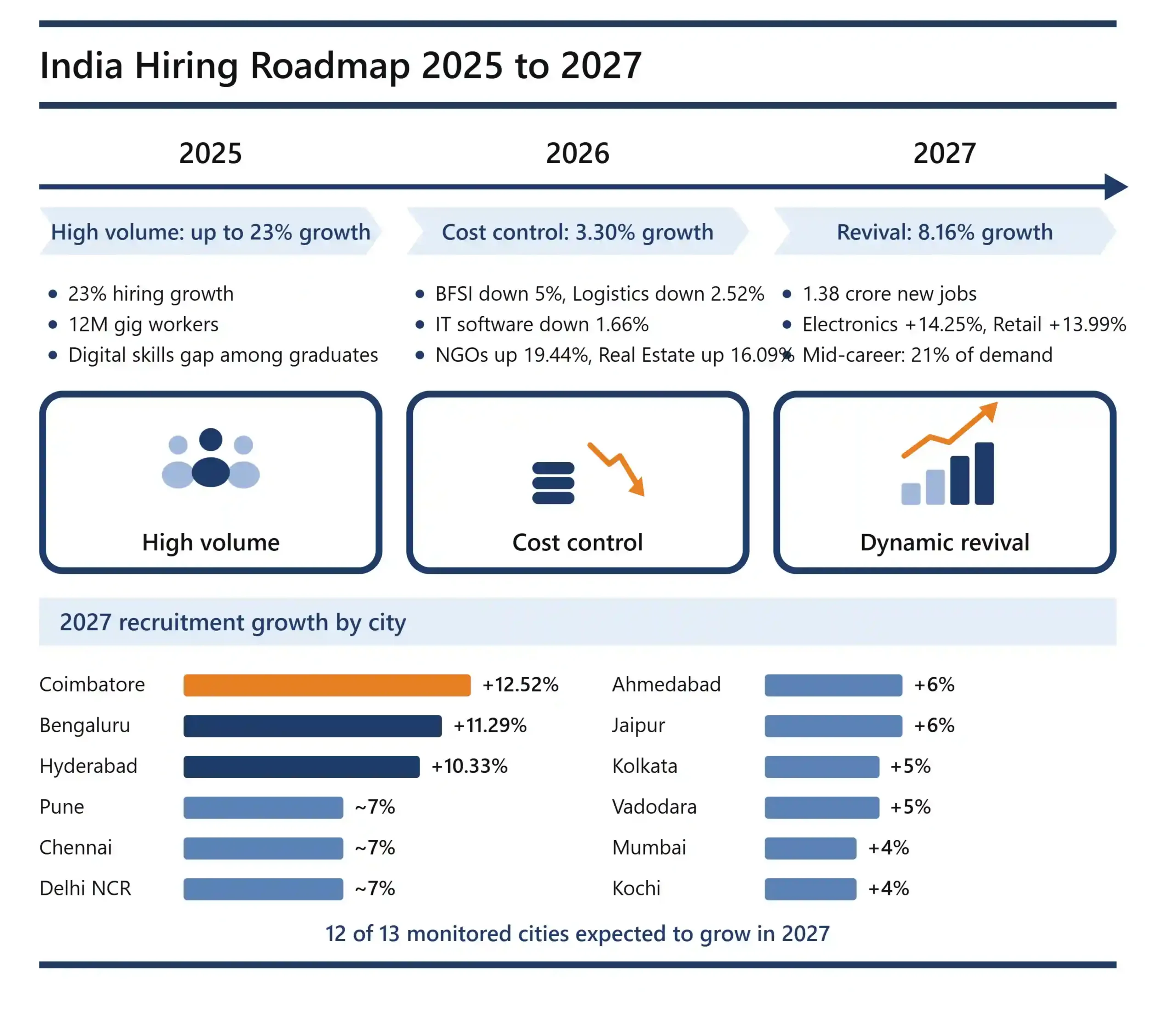
Up to 23% year-on-year growth in recruitment was noted. Furthermore, India’s gig economy expanded to 12 million people. Nevertheless, there was a notable skills gap and almost half of graduates did not have suitable digital skills for employment, creating costly attrition and repeated replacement cycles for corporate hiring teams.
2026 – Cost Control
White-collar recruitment grew by 3.30% (Jan–Oct 2026). Core industry sectors adopted a defensive position, with BFSI, Logistics, and IT software sectors witnessing falls in employment of 5%, 2.52%, and 1.66% respectively. Only Non-Profits (up +19.44%), Real Estate (+16.09%), and Travel (+13.76%) continued to fuel the market as employers prioritized budget discipline and leaner headcount approvals.
2027 – Dynamic Revival & Decentralisation
According to the India Hiring Trends Report 2027, employment is predicted to almost double, growing by 8.16% (equating to 1.38 crore jobs). Previously affected sectors are now again experiencing double-digit growth. Furthermore, recruitment is also decentralising, with Tier-2 industrial cities benefiting from expansion in manufacturing, Global Capability Centres (GCCs), and multi-city staffing demand.
2026 Vs 2027 Recruitment Growth
Comparing sector-by-sector data in the India Hiring Trends Report 2027 shows how sharply hiring demand shifts from defensive cost control in 2026 to targeted expansion in 2027 across consumer electronics, retail, manufacturing, and healthcare.
| Industry Sector | 2026 Recruitment Movement | 2027 Anticipated Growth | 2027 Growth Enablers |
| Consumer Electronics | Moderate growth | +14.25% | Domestic production; PLI (Production Linked Investment) policy; seasonal and rural markets |
| Retail | Steady | +13.99% | Opening of omnichannel retail outlets in Tier-2 and Tier-3 cities |
| Non-Profits | +19.44% | ~14.00% | Corporate social responsibility; environmental and sustainability initiatives |
| Real Estate | +16.09% | ~13.00% | GCC office space, storage and residential property |
| Manufacturing | Targeted growth | +12.02% | Diversification; Electric Vehicle and industrial facility development |
| Healthcare & Pharma | +12.34% | ~11.00% | Clinical research; specialised healthcare; health technology |
| Logistics & Supply Chain | -2.52% (fall) | +10.15% | Dark stores and cold chain development |
| BFSI | -5.00% (fall) | +10.03% | Digital finance; wealth; risk and compliance |
Leading Sectors and Experience Levels
Beyond IT and engineering, findings in the India Hiring Trends Report 2027 highlight rising demand for mid-career specialists (7–10 years of experience) and digitally skilled early-career talent as enterprises build internal capabilities.
- IT & Digital Engineering (+10.30%): Most in demand. Skills required include AI/ML, cloud, cyber security and data engineering.
- HR & Administration (+8.93%): Strong revival from 2026’s downturn as companies redevelop recruitment functions so they can support 2027 growth.
- Senior Management (+8.56%): Companies require senior personnel to manage change, governance and new geographical locations.
- Marketing, Finance and Medicine (~7%): Steady recruitment for marketing, financial and medical professionals.
Mid-career professionals (7-10 years’ experience) constitute 21% of overall recruitment demand. Furthermore, entry and early career roles are also expected to become available in 2027 as businesses expand.
Decentralisation: Why Tier-2 Cities are Surpassing Metro Cities
Another major takeaway from the India Hiring Trends Report 2027 is geographic decentralisation, with industrial and GCC hubs like Coimbatore, Bengaluru, Hyderabad, and Pune driving multi-city recruitment momentum.
Twelve of thirteen key monitored cities are predicted to demonstrate positive 2027 recruitment growth:
- Coimbatore (+12.52%): Has shown the strongest percentage growth. This is in contrast to its 2026 decline of 1.86% which was attributed to a lack of growth in engineering, precision industry and IT back office activity. Now, these sectors are flourishing.
- Bengaluru (+11.29%): Fuelled by Global Capability Centres (GCCs), AI product development and deep tech innovation.
- Hyderabad (+10.33%): Continues to benefit from pharmaceutical research, GCC and financial services.
- Pune, Chennai and Delhi NCR (~7%): Demonstrate well-rounded growth in automobile, SaaS, manufacturing and head office locations.
- Up and Coming Markets: Ahmedabad and Jaipur (+6%), then Kolkata and Vadodara (+5%) and finally Mumbai and Kochi (+4%).
Overcoming 2027 Recruitment Challenges
To turn projections from the India Hiring Trends Report 2027 into actual hires, HR leaders and business owners must address high attrition expectations, slow reactive hiring cycles, rigid return-to-office rules, and skill-proof gaps.
Issue 1 – High Staff Turnover and Pay Pressure
According to foundit’s Career Reset Survey 2027, 68.4% of Indian professionals intend to seek new employment in 2027 and 51.5% anticipate receiving a 31% or greater pay increase to do so.
Employer Action: Move beyond counter-offers. As the India Hiring Trends Report 2027 underscores, hiring demand is shifting toward skill-backed productivity—and since 40.3% of professionals seek career development and 56% desire hybrid working, employers should develop internal mobility processes, implement hybrid working policies, and tailor pay for key 7-10 year professionals.
Issue 2 – Delays in Recruiting for Specialist Roles
Most Indian organisations continue to adopt a ‘reactive’ approach to recruitment, whereby an employee’s manager initiates a recruitment request. Where 60%+ of employers are recruiting, this reactive approach causes time-to-fill issues which can last between 45-90 days.
Employer Action: Transition to proactive recruitment. Firstly, agree annual staffing numbers in line with industry sector standards. Then, identify and cultivate talent three months in advance for key skills (including AI, supply chain and industrial) and collaborate with niche recruitment agencies to source talent for Tier-2, multi-city areas—a key growth lever highlighted in the India Hiring Trends Report 2027.
Issue 3 – Restrictive Office Only Working Policies Limitting Recruitment Potential
Just 20.3% of Indian professionals want to work 100% in an office environment. Conversely, 79.7% seek hybrid or remote working. Consequently, those companies that insist on employees working in the office 5 days a week are likely to experience greater offer rejection rates.
Employer Action: Introduce flexible working. Whilst maintaining on-site presence for client facing and industrial roles, allow 2-3 days hybrid working for employees in technology, finance, HR and marketing. As the India Hiring Trends Report 2027 highlights, pairing targeted hybrid flexibility with skills-focused hiring will enhance recruitment potential without increasing wage expenditure.
Issue 4 – Difficulty for both Graduates and Mid-career Individuals in Demonstrating Their Worth
Despite 1.38 crore new jobs being available, employers are favouring candidates who can clearly evidence their skills and how they have delivered results. As the India Hiring Trends Report 2027 notes, hiring is shifting toward productivity-linked talent rather than headcount growth alone.
Employee Action: Shift away from graduate-focused CVs and towards showcasing tangible work experience. Combine specialist industry knowledge (for example in finance, operations, HR or engineering) with practical AI, analytical and quantifiable business related achievement experience.
FAQs
What are the key hiring figures in the India Hiring Trends Report 2027?
According to the India Hiring Trends Report 2027, India’s white-collar employment is projected to grow by 8.16%—creating around 1.38 crore new jobs, up sharply from 3.30% growth in 2026. Supported by a 54% Net Employment Outlook (ManpowerGroup) and a 5.4% workforce increase (TeamLease), employers are prioritizing productivity-linked talent over pure headcount expansion.
Which sectors and cities lead job growth in the India Hiring Trends Report 2027?
The India Hiring Trends Report 2027 highlights Consumer Electronics (+14.25%), Non-Profits (~14%), Retail (+13.99%), Real Estate (~13%), Manufacturing (+12.02%), and Healthcare & Pharma (~11%) among top growth sectors, alongside IT & Digital Engineering (+10.30%) and HR & Administration (+8.93%). Geographically, Coimbatore (+12.52%), Bengaluru (+11.29%), and Hyderabad (+10.33%) lead city growth as hiring decentralizes across Tier-1 and Tier-2 hubs.
How should employers hire graduates and 7–10 year professionals in 2027?
As the India Hiring Trends Report 2027 notes, mid-career professionals with 7–10 years of experience account for 21% of hiring demand, while 68.4% of Indian professionals plan to look for a new role (foundit Career Reset Survey 2027). Employers should combine structured career mobility and 2–3 day hybrid policies (desired by 56% of professionals) with practical skills assessments—including AI, analytics, and domain execution—for both mid-career specialists and early-career graduates.
Conclusion
The India Hiring Trends Report 2027 signals a decisive pivot from 2026’s cautious cost control toward 8.16% white-collar job growth—around 1.38 crore new roles—across high-demand sectors and fast-growing Tier-2 and Tier-1 cities. To capture this momentum without inflating hiring costs, employers must move from reactive requests to proactive talent pipelines, practical skills verification, internal mobility, and 2–3 day hybrid flexibility, while candidates stand out by proving real, measurable business impact.