Workforce Management Solutions: The Ultimate Guide to Improving Employee Productivity, Reducing Labor Costs, and Building a Smarter Workforce in 2026
Quick Answer
Workforce management solutions are advanced software systems and workforce strategies that help businesses manage employee scheduling, attendance, productivity, labor forecasting, payroll integration, compliance, and workforce optimization. These solutions improve operational efficiency, reduce labor costs, automate workforce operations, and enhance employee performance across industries such as healthcare, manufacturing, retail, logistics, hospitality, IT, and BPO.
Key Takeaways
- Workforce management solutions help businesses improve productivity and operational efficiency.
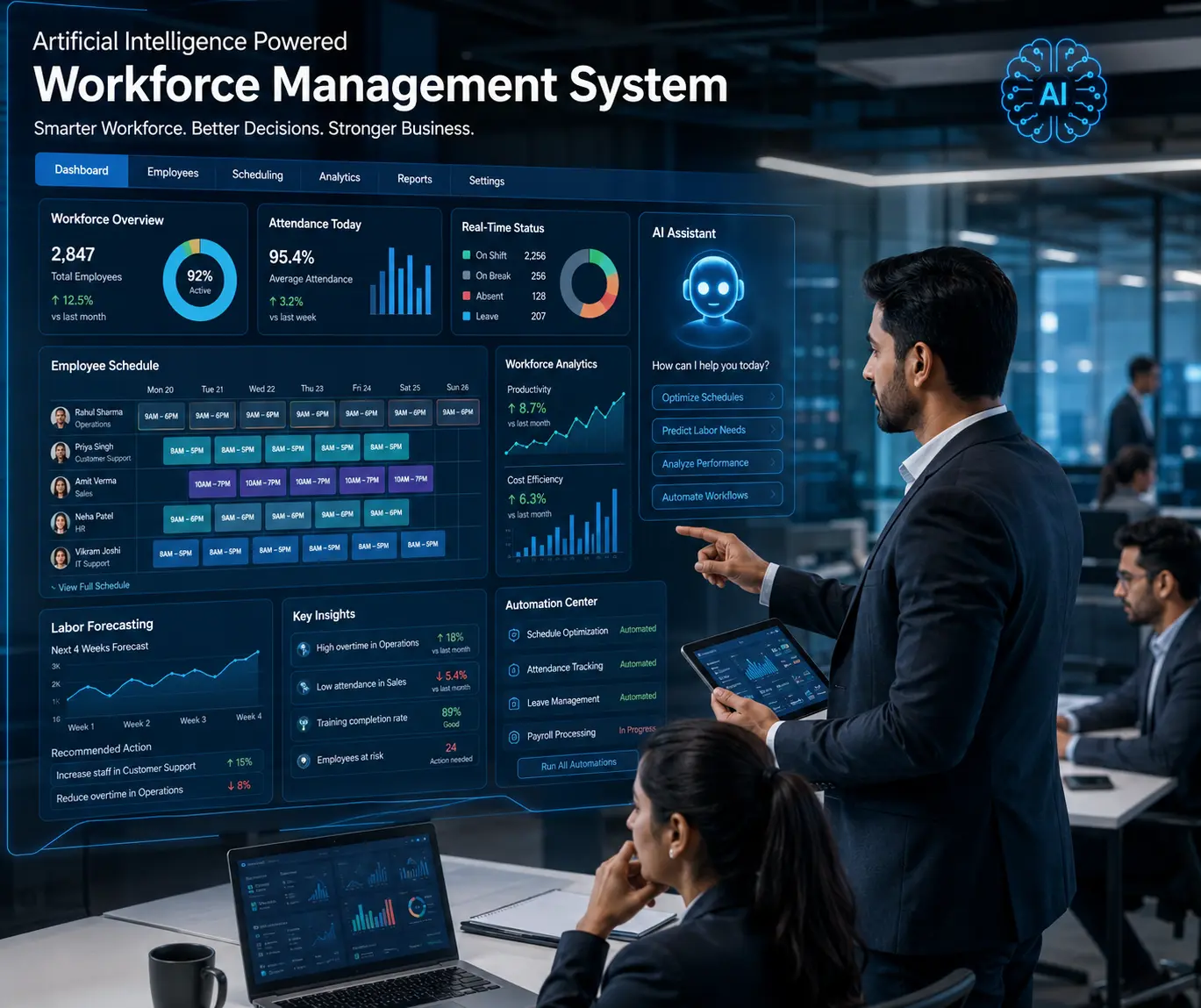
- AI-powered workforce management systems automate scheduling, forecasting, attendance tracking, and workforce analytics.
- Businesses can reduce overtime costs, absenteeism, and employee turnover with effective workforce management.
- Modern workforce solutions improve employee engagement and workforce visibility.
- Industries like healthcare, manufacturing, retail, logistics, and hospitality rely heavily on workforce optimization systems.
- Workforce analytics help organizations make smarter staffing and labor planning decisions.
- Cloud-based workforce management systems support remote, hybrid, and mobile workforce operations.
What Are Workforce Management Solutions?
Workforce management solutions are digital systems and operational strategies designed to help businesses efficiently manage employees, labor costs, productivity, attendance, scheduling, workforce forecasting, compliance, and employee performance.
Modern workforce management combines:
- workforce automation
- AI-powered scheduling
- labor analytics
- attendance tracking
- payroll integration
- workforce forecasting
- employee communication
- productivity management
The main goal of workforce management is to ensure the right employees are working at the right time while maximizing operational efficiency and improving employee experience.
Why Workforce Management Matters More Than Ever in 2026
Managing employees has become increasingly difficult for modern businesses. Rising labor costs, workforce shortages, remote work, employee burnout, and compliance requirements are forcing companies to adopt smarter workforce management strategies.
Traditional workforce systems based on spreadsheets and manual scheduling often create:
- scheduling conflicts
- payroll errors
- workforce inefficiencies
- employee dissatisfaction
- productivity loss
Modern workforce management solutions solve these challenges using automation, analytics, and real-time workforce intelligence.
What Is Workforce Management in HR?
Workforce management in HR refers to the process of optimizing employee productivity, attendance, labor forecasting, scheduling, workforce planning, and operational efficiency through workforce management software and strategic workforce planning methods.
Why Businesses Need Workforce Management Solutions
Businesses today face increasing operational pressure. Without proper workforce management systems, organizations often struggle with:
- understaffing
- overstaffing
- high overtime costs
- labor shortages
- employee absenteeism
- burnout
- shift conflicts
- payroll inaccuracies
- compliance risks
- communication gaps
A strong workforce management strategy helps businesses improve workforce visibility, labor optimization, and employee productivity.
Major Challenges Businesses Face Without Workforce Management Solutions
Scheduling Inefficiencies
Manual scheduling increases the risk of:
- overlapping shifts
- staffing shortages
- scheduling errors
- employee conflicts
Poor scheduling directly impacts productivity and customer service.
Rising Labor Costs
Inefficient workforce allocation increases:
- overtime expenses
- payroll costs
- administrative workload
Businesses lose significant revenue through poor labor management.
Employee Burnout and Turnover
Unbalanced workloads and inconsistent scheduling often lead to:
- employee stress
- low morale
- absenteeism
- higher turnover rates
Replacing employees can be expensive and time-consuming.
Compliance Risks
Businesses must comply with labor laws, overtime rules, attendance regulations, and workforce policies. Manual workforce processes increase the risk of compliance violations and penalties.
Lack of Workforce Visibility
Without workforce analytics, employers struggle to track:
- productivity
- attendance trends
- labor utilization
- workforce performance
Real-time workforce visibility is essential for operational efficiency.
Hidden Costs of Poor Workforce Management
Many businesses underestimate the financial impact of inefficient workforce operations.
Common hidden costs include:
- lost productivity
- overtime expenses
- recruitment costs
- employee turnover
- customer dissatisfaction
- payroll inaccuracies
- compliance fines
- operational inefficiencies
Modern workforce management systems help businesses reduce these unnecessary expenses.
Key Features of Workforce Management Solutions
Employee Scheduling
Automated scheduling tools help businesses:
- optimize shift planning
- reduce scheduling conflicts
- improve staffing efficiency
- match labor demand accurately
AI-powered scheduling systems can forecast staffing requirements automatically.
Time and Attendance Tracking
Modern workforce systems provide:
- biometric attendance
- GPS-based tracking
- mobile attendance
- real-time monitoring
This improves accountability and payroll accuracy.
Workforce Forecasting
Workforce forecasting tools help businesses predict:
- staffing requirements
- seasonal demand
- labor shortages
- workforce capacity
This improves operational planning.
Payroll Integration
Integrated workforce systems automatically calculate:
- work hours
- overtime
- leave balances
- payroll deductions
Automation reduces manual payroll errors.
Workforce Analytics
Advanced workforce analytics provide insights into:
- employee productivity
- labor costs
- attendance trends
- workforce efficiency
- staffing performance
Data-driven insights improve business decisions.
Mobile Workforce Access
Employees can:
- view schedules
- request leave
- swap shifts
- receive notifications
- access attendance records
This improves workforce communication and engagement.
What Are the Main Components of Workforce Management?
The main components of workforce management include:
- employee scheduling
- attendance tracking
- labor forecasting
- workforce analytics
- payroll integration
- compliance management
- productivity monitoring
- workforce planning
- employee communication
- labor optimization
Types of Workforce Management Solutions
Cloud-Based Workforce Management
Cloud workforce management systems provide:
- remote accessibility
- real-time updates
- scalability
- lower infrastructure costs
These systems are ideal for modern businesses with distributed teams.
AI-Powered Workforce Management
AI workforce systems use machine learning to:
- optimize scheduling
- forecast labor demand
- reduce overtime
- improve workforce planning
- identify productivity trends
AI-driven workforce intelligence is rapidly transforming workforce operations.
Mobile Workforce Management
Mobile workforce management systems support:
- remote employees
- field staff
- delivery teams
- hybrid workforce models
These solutions provide real-time workforce connectivity.
Enterprise Workforce Management
Large enterprises require advanced workforce systems with:
- multi-location management
- compliance automation
- workforce analytics
- ERP integration
- enterprise security
Workforce Management Solutions for Small Businesses
Small businesses increasingly use workforce automation to:
- improve productivity
- reduce administrative work
- automate scheduling
- optimize labor costs
Affordable cloud workforce tools make workforce management accessible for SMBs.
Benefits of Workforce Management Solutions
Improved Employee Productivity
Optimized scheduling and workforce planning help employees perform more efficiently.
Reduced Labor Costs
Businesses can reduce:
- overtime expenses
- overstaffing
- administrative costs
- payroll errors
Better workforce optimization improves profitability.
Better Employee Experience
Employees benefit from:
- flexible scheduling
- improved communication
- workload balance
- reduced burnout
- transparent workforce systems
A positive employee experience improves retention.
Increased Compliance
Automated compliance management reduces legal risks and labor violations.
Better Workforce Visibility
Real-time workforce analytics provide complete operational visibility.
Faster Decision-Making
Workforce intelligence helps managers make data-driven staffing decisions quickly.
Workforce Management Solutions by Industry
Healthcare Workforce Management
Healthcare organizations use workforce systems for:
- nurse scheduling
- emergency staffing
- overtime management
- workforce compliance
Retail Workforce Management
Retail businesses require:
- seasonal staffing
- peak-hour scheduling
- attendance tracking
- workforce forecasting
Manufacturing Workforce Management
Manufacturing companies use workforce systems for:
- shift rotation
- production workforce planning
- labor utilization
- productivity tracking
Logistics and Warehouse Workforce Management
Logistics businesses need:
- workforce coordination
- shift forecasting
- fleet workforce management
- real-time productivity monitoring
Hospitality Workforce Management
Hotels and restaurants use workforce management for:
- dynamic scheduling
- customer demand forecasting
- staff allocation
- attendance management
BPO and Call Center Workforce Management
BPO organizations require:
- call forecasting
- agent scheduling
- workforce analytics
- real-time monitoring
Workforce Management Solutions in India
Indian businesses are rapidly adopting workforce management solutions to improve operational efficiency, labor optimization, compliance management, and workforce productivity.
Industries driving workforce management adoption in India include:
- manufacturing
- logistics
- retail
- healthcare
- hospitality
- IT services
- e-commerce
- BPO
Cloud-based workforce systems are helping Indian businesses manage hybrid and distributed workforces more efficiently.
How AI Is Transforming Workforce Management
Artificial intelligence is changing how businesses manage employees and labor operations.
AI Scheduling
AI scheduling systems automatically create optimized shifts based on:
- employee availability
- labor demand
- productivity patterns
- compliance rules
Predictive Workforce Analytics
AI analytics identify:
- absenteeism risks
- staffing shortages
- workforce bottlenecks
- turnover risks
This helps businesses proactively improve workforce planning.
Workforce Forecasting
AI forecasting improves staffing accuracy during:
- seasonal demand
- business growth
- operational expansion
- peak workloads
Employee Sentiment Analysis
Advanced workforce systems analyze employee feedback to improve engagement and reduce turnover.
Traditional Workforce Management vs AI Workforce Management
| Feature | Traditional Workforce Management | AI Workforce Management |
|---|---|---|
| Scheduling | Manual | Automated |
| Forecasting | Limited | Predictive |
| Analytics | Basic | Real-Time |
| Productivity Tracking | Slow | Advanced |
| Compliance Monitoring | Manual | Automated |
| Labor Optimization | Limited | Intelligent |
| Workforce Visibility | Partial | Full Real-Time Visibility |
Workforce Management KPIs Every Employer Should Track
Employee Turnover Rate
Measures workforce retention and employee satisfaction.
Labor Cost Percentage
Tracks workforce spending efficiency.
Overtime Hours
Identifies scheduling inefficiencies and labor cost issues.
Absenteeism Rate
Measures workforce reliability and attendance trends.
Productivity Per Employee
Evaluates operational workforce performance.
Schedule Adherence
Tracks punctuality and shift compliance.
Workforce Management vs HRMS vs HRIS
| Feature | Workforce Management | HRMS | HRIS |
|---|---|---|---|
| Employee Scheduling | Yes | Limited | No |
| Attendance Tracking | Advanced | Basic | Basic |
| Workforce Forecasting | Yes | No | No |
| Labor Analytics | Advanced | Moderate | Limited |
| Payroll Integration | Yes | Yes | Partial |
| Compliance Management | Strong | Moderate | Basic |
How to Choose the Best Workforce Management Solution
Consider Your Industry Requirements
Different industries require different workforce capabilities.
Evaluate Scalability
Choose a workforce solution that can grow with your business.
Check Integration Capabilities
Ensure the system integrates with:
- payroll software
- HR systems
- ERP platforms
- attendance systems
Prioritize User Experience
Managers and employees should be able to use the platform easily.
Analyze Reporting and Analytics
Advanced workforce reporting improves operational visibility and decision-making.
Common Workforce Management Mistakes Businesses Should Avoid
Relying on Manual Scheduling
Manual workforce processes increase errors and inefficiencies.
Ignoring Workforce Analytics
Without workforce data, businesses make reactive decisions instead of strategic ones.
Poor Communication
Lack of workforce communication causes scheduling confusion and productivity loss.
Inaccurate Workforce Forecasting
Poor forecasting creates staffing shortages or overstaffing problems.
Ignoring Employee Feedback
Employee dissatisfaction negatively impacts productivity and retention.
Example of Workforce Management Improvement
A manufacturing company struggling with overtime costs and absenteeism implemented an AI-powered workforce management system.
Within six months, the company:
- improved scheduling efficiency
- reduced overtime expenses
- increased workforce productivity
- improved attendance accuracy
- enhanced employee engagement
This demonstrates how workforce automation improves operational performance.
Workforce Management Statistics in 2026
- Companies using AI workforce scheduling reduce scheduling time significantly.
- Poor workforce planning can increase labor costs by 15–25%.
- Businesses with optimized workforce management report better employee retention.
- Workforce analytics improve operational efficiency and staffing accuracy.
- Employee burnout remains one of the biggest workforce challenges globally.
- Cloud workforce management adoption continues to grow rapidly across industries.
Future Trends in Workforce Management
AI-Powered Workforce Intelligence
AI-driven workforce optimization will become a standard business requirement.
Hybrid Workforce Management
Businesses will increasingly manage remote and on-site employees simultaneously.
Real-Time Workforce Analytics
Real-time workforce dashboards will improve operational visibility.
Gig Workforce Expansion
Contract and freelance workforce management will become increasingly important.
Employee Experience Optimization
Businesses will prioritize employee well-being and workforce flexibility.
People Also Ask (PAA)
What is workforce management software?
Workforce management software helps businesses manage employee scheduling, attendance, labor forecasting, productivity, payroll integration, and workforce optimization.
How do workforce management solutions improve productivity?
These solutions automate workforce operations, optimize staffing, reduce scheduling errors, and improve workforce visibility.
What industries use workforce management systems?
Healthcare, retail, manufacturing, logistics, hospitality, BPO, IT, and construction industries commonly use workforce management systems.
Is workforce management suitable for small businesses?
Yes. Many cloud-based workforce management solutions are affordable and scalable for small businesses.
What is AI workforce management?
AI workforce management uses artificial intelligence to automate scheduling, forecasting, workforce analytics, and labor optimization.
How does workforce management reduce labor costs?
It reduces overtime, improves staffing efficiency, minimizes scheduling errors, and automates workforce operations.
Can workforce management systems integrate with payroll?
Yes. Most modern workforce management platforms integrate with payroll and HR software.
What are workforce management KPIs?
Common KPIs include employee turnover, absenteeism, labor costs, overtime hours, productivity rates, and schedule adherence.
About the Author
This article was created by professionals with expertise in workforce management, recruitment consulting, HR operations, staffing solutions, labor optimization, and employee productivity management. The insights shared are based on modern workforce trends, operational best practices, employer pain points, and workforce technology advancements.
Final Thoughts
Modern businesses cannot rely on outdated workforce processes anymore.
Rising labor costs, workforce shortages, compliance requirements, and employee expectations are making workforce optimization a business necessity.
Advanced workforce management solutions help businesses:
- improve productivity
- reduce operational costs
- optimize labor planning
- automate scheduling
- enhance employee engagement
- improve workforce visibility
- strengthen compliance management
Whether you run a small business, enterprise organization, manufacturing company, healthcare operation, retail chain, or logistics business, investing in intelligent workforce management systems can improve operational efficiency and long-term business growth.
As AI, automation, and workforce analytics continue evolving, businesses that adopt modern workforce management strategies will gain a major competitive advantage in 2026 and beyond.