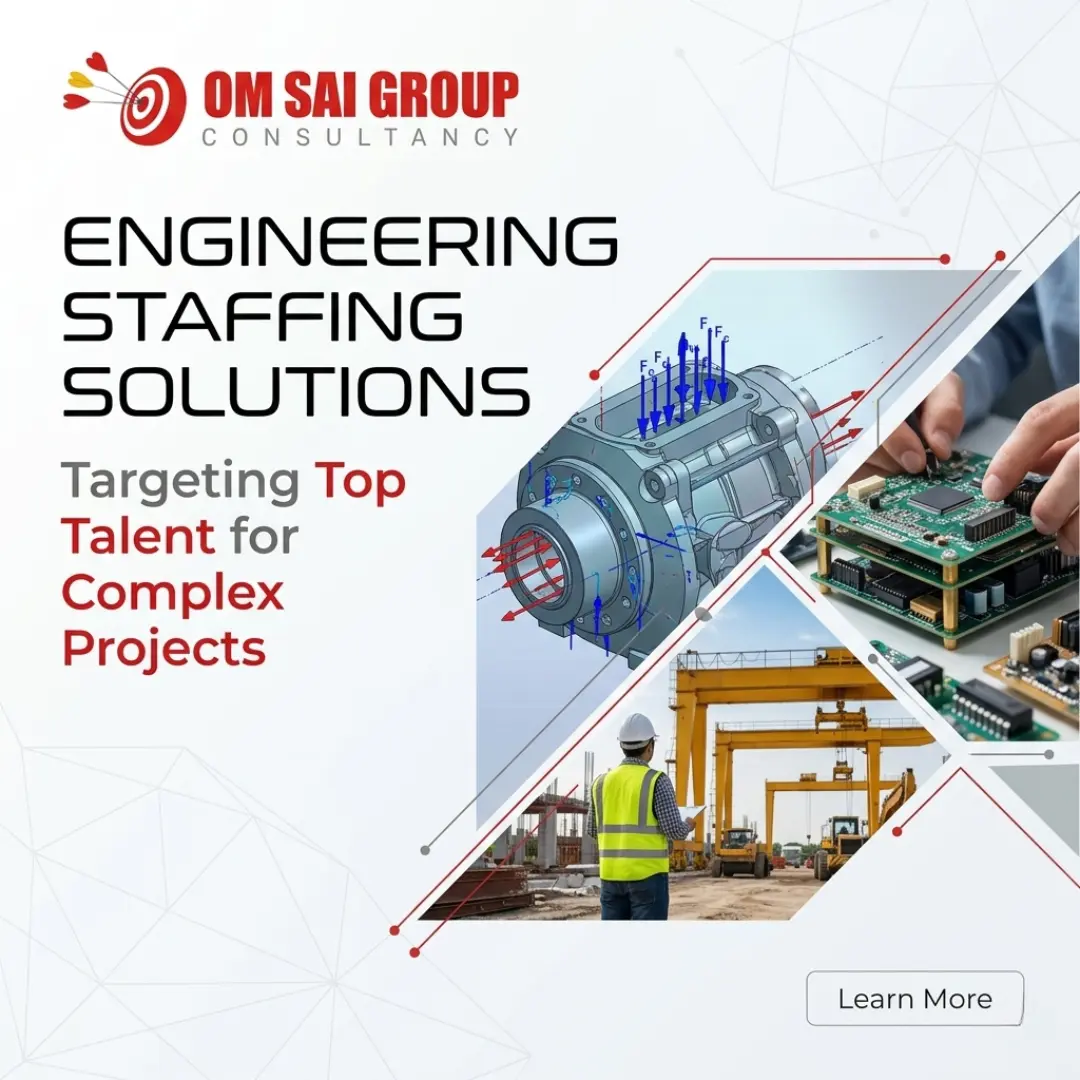
Engineering Staffing Solutions: Building Skilled Technical Teams for Business Growth
Engineering drives innovation across manufacturing, construction, infrastructure, energy, automotive, technology, and industrial businesses. However, even the best projects can face delays when companies cannot find qualified engineers at the right time.
Modern employers need more than resumes. They need professionals with relevant technical knowledge, practical experience, industry exposure, and the ability to work within project timelines. This is where Engineering Staffing Solutions help businesses build capable technical teams without increasing the workload of internal HR departments.
A professional engineering recruitment partner understands the difference between hiring a design engineer, production engineer, project engineer, quality engineer, maintenance engineer, or plant head. Each role requires different technical skills, qualifications, certifications, and industry experience.
At Om Sai Group Consultancy, engineering recruitment is managed through a structured process. The team studies the employer’s requirements, sources relevant professionals, conducts initial screening, coordinates interviews, and supports the hiring process until successful joining.
The objective is simple: help companies hire suitable engineering talent faster while maintaining quality and relevance.
What Are Engineering Staffing Solutions?
Engineering staffing solutions are professional recruitment services designed to help businesses hire engineers, technical specialists, project professionals, and engineering leaders.
These services may support permanent hiring, contract staffing, project-based recruitment, bulk engineering hiring, and senior-level talent acquisition.
The process usually includes:
- Understanding the engineering requirement
- Reviewing the job description
- Identifying required technical skills
- Sourcing suitable candidates
- Screening resumes
- Conducting preliminary evaluations
- Coordinating technical interviews
- Supporting offer discussions
- Assisting with joining and onboarding
Engineering staffing is not only about filling an open position. It also supports workforce planning, project delivery, operational continuity, and long-term business growth.
Why Engineering Companies Need Specialized Recruitment Support
Engineering hiring can be difficult because technical roles often require specialized knowledge. A general recruitment process may not accurately identify whether a candidate has the right experience for a particular project or industry.
For example, a mechanical engineer with automotive production experience may not be suitable for a process engineering role in a chemical plant. Similarly, a civil engineer experienced in residential construction may require different expertise for an infrastructure project.
Specialized recruitment support helps employers evaluate candidates according to the actual needs of the position.
Common engineering hiring challenges include:
- Shortage of experienced technical professionals
- High competition for skilled engineers
- Large numbers of irrelevant applications
- Long recruitment cycles
- Urgent project staffing requirements
- Difficulty assessing technical experience
- Candidate offer dropouts
- High employee turnover
- Limited access to passive candidates
A structured engineering recruitment process helps reduce these challenges and improves the quality of shortlisted candidates.
Types of Engineering Professionals Companies Hire
Engineering businesses require talent across multiple disciplines. The exact requirement depends on the company’s industry, technology, project scope, and operational goals.
Mechanical Engineers
Mechanical engineers may work in product design, manufacturing, maintenance, production, quality, automotive, industrial equipment, and plant operations.
Common roles include:
- Mechanical Design Engineer
- Production Engineer
- Maintenance Engineer
- Quality Engineer
- Project Engineer
- Plant Engineer
Electrical Engineers
Electrical engineers support power systems, industrial automation, electrical design, maintenance, energy projects, and equipment operations.
Common roles include:
- Electrical Design Engineer
- Electrical Maintenance Engineer
- Power Systems Engineer
- Automation Engineer
- Project Engineer
Civil Engineers
Civil engineering recruitment may involve construction, infrastructure, real estate, highways, bridges, industrial projects, and project management.
Common roles include:
- Site Engineer
- Planning Engineer
- Structural Engineer
- Billing Engineer
- Project Manager
- Construction Manager
Electronics and Instrumentation Engineers
These professionals support automation, control systems, industrial instrumentation, electronics design, testing, and process operations.
Chemical and Process Engineers
Chemical and process engineers are often required in pharmaceuticals, chemicals, energy, oil and gas, food processing, and manufacturing.
Software and Technology Engineers
Engineering organizations also hire software professionals for automation, embedded systems, industrial applications, data analysis, and digital transformation.
Engineering Staffing Solutions for Different Industries
Engineering recruitment requirements vary across industries. A customized hiring strategy helps employers find professionals with relevant domain experience.
| Industry | Common Engineering Roles |
| Manufacturing | Production Engineer, Quality Engineer, Plant Manager |
| Automotive | Design Engineer, Process Engineer, Testing Engineer |
| Construction | Site Engineer, Project Engineer, Civil Engineer |
| Infrastructure | Planning Engineer, Structural Engineer, Project Manager |
| Energy | Electrical Engineer, Maintenance Engineer, Project Specialist |
| Pharmaceuticals | Validation Engineer, Process Engineer, Maintenance Engineer |
| Oil and Gas | Mechanical Engineer, Pipeline Engineer, Safety Engineer |
| Information Technology | Software Engineer, Automation Engineer, Systems Engineer |
| Aerospace | Design Engineer, Quality Engineer, Manufacturing Engineer |
| Industrial Automation | PLC Engineer, Control Engineer, Instrumentation Engineer |
A recruitment strategy should consider both technical qualifications and industry-specific experience.
How Om Sai Group Consultancy Manages Engineering Recruitment
Om Sai Group Consultancy follows a structured recruitment process to help employers identify suitable engineering professionals.
1. Understanding the Employer’s Requirement
The process begins with a detailed discussion with the employer.
The recruitment team gathers information about:
- Job title
- Technical responsibilities
- Required qualifications
- Years of experience
- Industry background
- Software or technical tools
- Salary range
- Work location
- Joining timeline
This information helps create a focused hiring strategy.
2. Job Description Analysis
The recruitment team reviews the job description to identify essential and preferred requirements.
This step helps separate critical skills from additional skills. As a result, candidate sourcing becomes more accurate.
3. Engineering Talent Sourcing
Suitable candidates may be sourced through multiple channels, including:
- Internal candidate databases
- Professional job portals
- Industry networks
- Employee referrals
- Professional networking platforms
- Targeted candidate outreach
- Passive talent searches
Using multiple sourcing channels improves access to both active and passive candidates.
4. Resume Screening
Candidate profiles are reviewed against the employer’s requirements.
The screening process may consider:
- Educational qualifications
- Relevant engineering experience
- Industry exposure
- Technical skills
- Project experience
- Employment history
- Location preferences
- Career objectives
Only relevant profiles move to the next stage.
5. Preliminary Candidate Evaluation
Recruiters conduct initial discussions to understand the candidate’s experience, communication ability, job expectations, availability, and interest in the opportunity.
Technical suitability is assessed according to the role requirements. Final technical evaluation remains with the employer or designated technical interview panel.
6. Shortlisting and Employer Presentation
Suitable candidates are shortlisted and shared with the employer.
This helps hiring managers focus on relevant profiles instead of reviewing a large number of unsuitable applications.
7. Interview Coordination
The recruitment team assists with:
- Interview scheduling
- Candidate communication
- Interview reminders
- Feedback collection
- Follow-up coordination
This reduces administrative work for both the employer and the candidate.
8. Offer and Joining Support
After selection, the team supports communication during the offer stage and follows up with the candidate until joining.
This helps reduce avoidable delays and improves the overall recruitment experience.
Permanent Engineering Recruitment
Permanent engineering recruitment is suitable for businesses that need long-term technical employees.
This model is commonly used for:
- Core engineering roles
- Plant operations
- Product development
- Quality management
- Maintenance teams
- Technical leadership
- Research and development
Permanent employees can build institutional knowledge and contribute to long-term business goals.
However, employers should evaluate technical competence, career stability, cultural alignment, and future growth potential before making a final decision.
Contract Engineering Staffing
Contract engineering staffing provides flexibility when companies need professionals for a specific period or project.
It may be useful for:
- Short-term projects
- Seasonal workload increases
- Plant shutdowns
- Infrastructure projects
- New facility setup
- Technical implementation
- Temporary skill requirements
Contract staffing can help organizations scale their workforce according to operational needs.
Bulk Engineering Hiring
Large engineering projects may require multiple professionals within a short period.
Bulk recruitment can support:
- New plant operations
- Manufacturing expansion
- Construction projects
- Infrastructure development
- Production ramp-up
- New project teams
A successful bulk hiring plan requires clear workforce forecasting, defined job requirements, fast screening, and organized interview coordination.
Benefits of Working With an Engineering Staffing Agency
Professional engineering staffing support can provide several benefits.
Faster Access to Relevant Talent
Recruitment partners may maintain candidate networks and industry connections that help reduce sourcing time.
Reduced HR Workload
External recruitment support can reduce the time spent on resume collection, initial screening, follow-ups, and interview coordination.
Better Candidate Targeting
A focused search strategy can improve the relevance of shortlisted profiles.
Flexible Hiring Support
Businesses can use recruitment services for permanent roles, contract positions, project hiring, or large-scale workforce requirements.
Improved Hiring Coordination
Structured communication helps employers manage interviews, feedback, offers, and joining activities more efficiently.
Common Mistakes in Engineering Hiring
Employers can improve hiring outcomes by avoiding common recruitment mistakes.
Using an Unclear Job Description
A vague job description attracts unsuitable applications.
The role should clearly define responsibilities, required skills, experience, location, and reporting structure.
Focusing Only on Qualifications
A degree is important, but practical experience may be equally valuable.
Employers should also evaluate project exposure, technical application, problem-solving ability, and industry knowledge.
Delaying Interview Feedback
Skilled engineers may receive multiple opportunities.
Slow communication can result in candidate dropouts.
Ignoring Long-Term Fit
A candidate may meet the technical requirements but have different career expectations.
Discussing growth opportunities and role expectations can improve retention.
Hiring Only Through One Source
Using multiple sourcing channels can increase access to diverse engineering talent.
Why Companies Choose Om Sai Group Consultancy
Om Sai Group Consultancy supports employers with recruitment solutions designed around business requirements.
The consultancy focuses on:
- Understanding technical hiring needs
- Targeted candidate sourcing
- Initial profile screening
- Role-based candidate evaluation
- Interview coordination
- Employer communication
- Offer and joining support
- Recruitment support across multiple industries
The approach combines recruitment expertise with an understanding of employer expectations.
For engineering organizations, the goal is not to send the highest number of resumes. The focus is to identify relevant candidates who match the role, industry, and hiring requirements.
How to Choose the Right Engineering Staffing Partner
Before selecting a recruitment agency, employers should evaluate several factors.
Ask these questions:
- Does the agency understand engineering roles?
- Can it support your industry and location?
- What sourcing methods does it use?
- How are candidates screened?
- Does it support technical and leadership hiring?
- Can it manage bulk or project-based recruitment?
- How does it coordinate interviews and joining?
- Does it provide clear communication throughout the process?
A reliable recruitment partner should understand the employer’s workforce goals rather than simply forwarding resumes.
Frequently Asked Questions
1. What are engineering staffing solutions?
Engineering staffing solutions help companies recruit engineers, technical specialists, project professionals, and engineering leaders for permanent, contract, or project-based roles.
2. What types of engineers can be recruited?
Companies may hire mechanical, electrical, civil, chemical, process, software, automation, instrumentation, and other engineering professionals.
3. How do engineering recruitment services save time?
Recruitment agencies manage sourcing, initial screening, candidate communication, and interview coordination. This reduces the administrative workload of internal HR teams.
4. Can engineering staffing support bulk hiring?
Yes. A structured recruitment plan can support large-scale hiring for new projects, plants, facilities, production expansion, and infrastructure operations.
5. What is the difference between permanent and contract engineering staffing?
Permanent recruitment focuses on long-term employment. Contract staffing supports temporary, project-based, or fixed-duration workforce requirements.
6. How are engineering candidates screened?
Screening may include qualification review, relevant experience, technical skills, industry exposure, communication, job expectations, and role suitability.
7. Why is industry experience important in engineering hiring?
Industry experience helps candidates understand relevant processes, standards, equipment, technologies, and project requirements.
8. Can a recruitment agency help with senior engineering roles?
Yes. Recruitment support may include senior engineers, project managers, plant heads, engineering managers, and technical leadership positions.
9. How can companies reduce engineering hiring delays?
Clear job descriptions, quick interview scheduling, timely feedback, and structured candidate communication can reduce delays.
10. How can Om Sai Group Consultancy support engineering employers?
Om Sai Group Consultancy supports requirement analysis, candidate sourcing, profile screening, interview coordination, offer communication, and joining follow-up.
Conclusion
Engineering talent plays a direct role in project delivery, product quality, operational efficiency, innovation, and business growth. Therefore, companies need a recruitment process that evaluates technical relevance as well as long-term suitability.
Effective Engineering Staffing Solutions help employers access qualified professionals, reduce hiring delays, and build stronger technical teams.
Whether a company requires one experienced engineer, a project team, technical specialists, or large-scale engineering manpower, a structured recruitment strategy can improve hiring outcomes.
Om Sai Group Consultancy helps employers manage engineering recruitment through targeted sourcing, candidate screening, interview coordination, and joining support. Businesses looking to strengthen their engineering workforce can use professional recruitment support to build capable teams and support sustainable growth.