

Remote Jobs Means: Complete Work From Home & Hybrid Guide (2026)
Remote jobs means employment roles where professionals perform their daily duties from home, a co-working space, or any location outside a traditional corporate office using the internet. In 2026, companies across IT, digital marketing, HR, finance, and customer support widely offer remote jobs to hire top talent without geographic limits.
Whether you are a fresher searching job portals or an experienced professional looking for flexibility, understanding what remote means in job descriptions helps you apply to the right opportunities and avoid misleading listings.
What Does Remote Means in Job Postings?
In job postings, remote means in job listings that you do not need to commute to a physical office building to complete your work. Instead, communication, project tracking, and meetings happen online via tools like Zoom, Microsoft Teams, Slack, and Google Workspace.
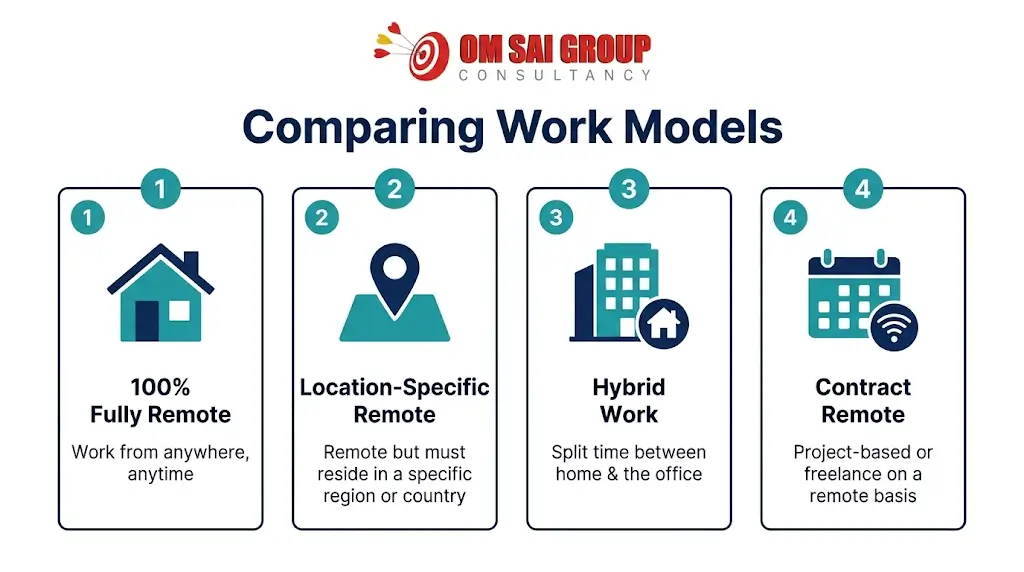
However, employers classify remote opportunities into different categories depending on location rules and working hours. Checking these labels before applying ensures the role matches your lifestyle and location.
4 Types of Remote Jobs Explained
Not every remote position allows you to work from anywhere in the world. Below are the four most common remote work models used by Indian and global employers:
| Remote Job Type | Where You Work | Attendance / Travel Rules | Best Suited For |
|---|---|---|---|
| 100% Fully Remote (Work From Anywhere) | Anywhere with stable internet (any city or country) | Zero office visits required | Software developers, writers, designers, digital marketers |
| Remote (Location-Specific / State-Bound) | From home, within a specific city or state (e.g., Delhi NCR or Bangalore) | Occasional client visits or regional tax compliance | HR recruiters, regional sales, account managers |
| Hybrid Remote | Mix of home (2–3 days) and corporate office (2–3 days) | Fixed weekly office days mandatory | Mid-to-senior corporate roles, banking, IT teams |
| Temporary / Contract Remote | From home for a fixed project duration (3–12 months) | Project-based milestones, no permanent office seat | Consultants, QA testers, seasonal support staff |
Remote Jobs vs. Work From Home (WFH): Key Differences
While people often use both terms interchangeably, there is a clear operational difference between a permanent remote role and a standard work-from-home arrangement:
- Infrastructure & Setup: Remote jobs means the company is built for distributed work with cloud tools, async workflows, and digital onboarding, whereas WFH is often a temporary perk given to regular office employees.
- Location Flexibility: True remote roles let you work from a café, co-working space, or hometown, while WFH policies usually require you to stay in the same city as the office for emergency reporting.
- Career Growth: Remote-first companies evaluate performance strictly on output and deliverables rather than physical office hours.
Top 7 Benefits of Remote Jobs for Professionals & Employers
Remote work has become a permanent pillar of modern recruitment because it creates measurable value for both candidates and businesses:
- Zero Daily Commute: Professionals save 1 to 3 hours daily in metro cities like Delhi NCR, Bangalore, and Mumbai, reducing travel stress and fuel costs.
- Better Work-Life Balance: Flexible schedules make it easier to manage personal health, family responsibilities, and upskilling alongside full-time work.
- Higher Cost Savings: Employees save significantly on rent, relocation, daily meals, and formal office attire, increasing their net monthly savings.
- Access to Pan-India & Global Salaries: Candidates in Tier-2 and Tier-3 cities can work for top MNCs and earn competitive metro-level packages without relocating.
- Increased Productivity: Fewer office distractions allow deep, focused work, leading to faster project delivery.
- Wider Talent Pool for Employers: Companies partnering with experienced recruitment agencies can hire specialized talent across India rather than limiting searches to one city.
- Lower Office Overhead: Businesses save up to 30%–40% on commercial real estate, electricity, and facility maintenance expenses.
Highest-Paying Remote Jobs in India (2026)
If you are planning to switch to a remote career, these high-demand domains offer strong salary growth and abundant openings:
- Software & Full-Stack Development: ₹6 LPA – ₹24 LPA
- Digital Marketing & SEO Specialists: ₹4 LPA – ₹15 LPA
- HR & Talent Acquisition (Remote Recruiters): ₹3.5 LPA – ₹12 LPA
- Content Writing, Copywriting & UX Writing: ₹3.5 LPA – ₹10 LPA
- Data Analytics & Business Intelligence: ₹6 LPA – ₹20 LPA
- Customer Success & International BPO Support: ₹3 LPA – ₹8 LPA
(Tip: Check out our complete India Salary Guide 2026 to compare city-wise and role-wise pay scales.)
How to Spot Genuine Remote Jobs & Avoid Scams
With rising demand for remote roles, fake job postings have also increased. Follow these quick checks before sharing personal documents:
- Verify the Official Domain: Always check that interview emails come from an official company domain (e.g.,
@companyname.com) rather than free Gmail or Yahoo addresses. - Never Pay Registration Fees: Genuine employers and trusted recruitment agencies like Om Sai Group Consultancy never charge candidates for interviews, laptops, or offer letters.
- Confirm Expectations Early: During HR screening, clearly ask whether the role is 100% remote, hybrid, or remote only until office reopening.
- Verify the Official Domain: Always check that interview emails come from an official company domain (e.g.,
Frequently Asked Questions (FAQs)
1. What does remote jobs means in simple words?
Remote jobs means working for a company from your home or any location outside a traditional office using a laptop and internet connection. All meetings, tasks, and team updates happen online.
2. Is a remote job permanent or temporary?
It depends on the employment contract. Many IT, digital, and consulting companies offer permanent 100% remote jobs, while some organizations offer temporary remote work during onboarding or specific projects.
3. Can freshers get remote jobs in India?
Yes. Freshers can easily get remote jobs in customer support, content writing, digital marketing, HR recruitment, data entry, and junior software development by highlighting strong communication and digital collaboration skills.
4. What does “Remote (Hybrid)” mean on job portals?
“Remote (Hybrid)” means you will split your workweek between working from home and commuting to the physical office—typically 2 to 3 days in the office and the rest remotely.
5. What equipment do I need for a remote job?
You need a reliable laptop or desktop computer, high-speed broadband internet (minimum 50 Mbps), a quiet workspace, a webcam, and noise-canceling headphones for virtual meetings.
Looking for Verified Remote, Hybrid, or Corporate Jobs in India?
Whether you are a job seeker looking for genuine remote opportunities or an employer hiring verified remote talent across India, Om Sai Group Consultancy connects you with the right match quickly and transparently.
- Explore Current Openings & Hiring Solutions: Visit Om Sai Group Consultancy
- Call Our Recruitment Team: +91 7503979405 / +91 9718983381 / 011-49028223
- Send Your CV or Hiring Inquiry: hr@omsaigroupconsultancy.com